SG, Kookaburra and Dukes
There is no single “cricket ball.” Three companies make the balls used in Test cricket, they are stitched differently, and that one difference quietly decides what kind of cricket each country plays.
By The Cricket Daily Desk · 6 min read
We've talked about “the ball” as if it were one object. It isn't. Test cricket is played with three different balls, made by three companies on three continents, and a touring batter walking out in an unfamiliar country is often facing an unfamiliar ball as much as an unfamiliar pitch. The differences look tiny — they're mostly in how the seam is sewn — but they cascade all the way up into how teams are built and how matches are won.
Who uses what
The map is simple to learn. Dukes balls are used in England, the West Indies and Ireland. SG balls are used in India. Kookaburra balls are used by everyone else in Test cricket — Australia, New Zealand, South Africa, Sri Lanka, Pakistan, Bangladesh — and in essentially all white-ball international cricket worldwide. So most of the planet plays with a Kookaburra; two significant exceptions, England and India, do not. Hold onto that, because those two exceptions are where a lot of swing and seam history is made.
The one difference that matters: the seam
Everything traces back to the seam — the raised ridge from Part 2 — and specifically to how it's stitched.
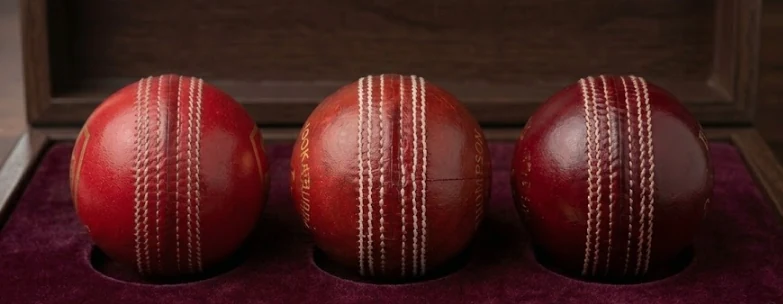
Dukes are hand-stitched through all six rows, which builds a pronounced, “proud” seam on greased leather that stands up and lasts. That proud, durable seam is why a Dukes ball swings the most and the longest, holds its shape deep into an innings, and still has enough seam integrity late on to reverse.
SG, India's ball, is also hand-stitched and carries the most prominent seam of the three. It does much of its work off the pitch as well as in the air, and because the seam stays proud it keeps helping bowlers — and spinners — deep into the game, on the abrasive subcontinental surfaces that also bring reverse swing on early.
Kookaburra is the outlier. Only its inner rows are hand-stitched — just enough to hold the two halves together — while the outer rows are machine-stitched, there mainly to give the bowler's fingers something to grip. The result is a harder, flatter seam that goes quiet fast. A Kookaburra tends to swing in a sharp early window, the first ten or fifteen overs, and then flatten off and do relatively little.
Why a seam profile changes the whole game
Think of the seam as the ball's rudder, as we did earlier. A rudder that stays proud and firm keeps steering for longer — more overs of swing, more seam movement, and enough structure late in the innings for reverse. That's the Dukes and the SG. A rudder that flattens quickly gives you one sharp burst and then stops. That's the Kookaburra.
Now watch what that does to how teams play. In England, with a Dukes that keeps swinging past the thirtieth over, you build an attack around bowlers who move the ball for long spells. In Australia, with a Kookaburra that goes quiet after fifteen overs, prolonged swing isn't on the menu, so you build around raw pace, bounce and hard length instead — which is exactly the cricket Australia is famous for. The ball isn't just equipment; it's a large part of why national styles differ at all.
It also means home advantage is, quite literally, partly the ball. A touring bowler used to a Kookaburra's brief window can't exploit a Dukes' long one; a batter raised on a flat-seam Kookaburra can be undone by an SG that keeps nipping and reversing. Before a single ball is bowled, the manufacturer has tilted the contest toward the side that grew up with it.
An open argument
One honest debate to flag rather than settle. Some in the game — the former New Zealand bowler Simon Doull among them — have argued that balls made since around 2015 swing less regardless of maker, pointing to white-ball cricket in particular. Others, like Ian Bishop, aren't convinced. Whether the modern ball genuinely moves less, or bowlers just remember a swingier past, is unresolved. It's worth knowing the argument exists; it isn't worth pretending it's decided.
So three factories, three seams, three subtly different games. But the ball is only half the story of where and when it swings. The other half is the ground you're standing on and the number on the over-counter — because a ball at over sixty is a different animal from the one at over one. That's the last piece.