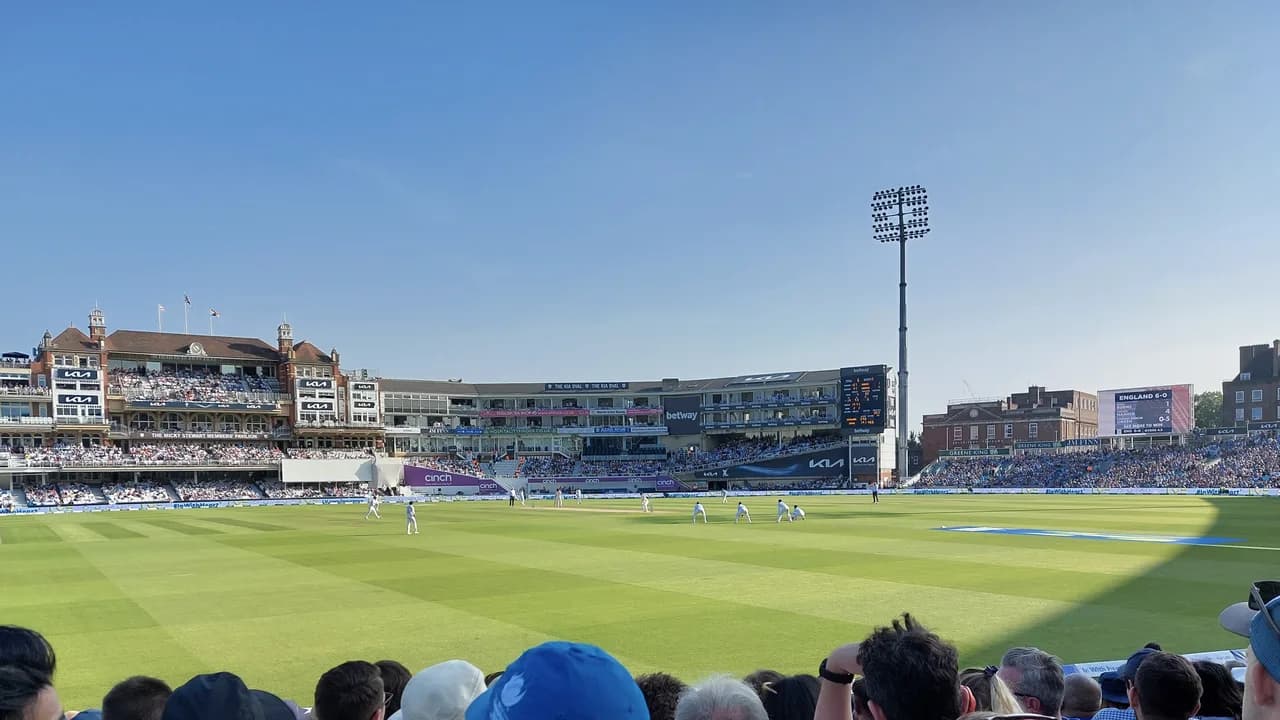
India v England
In the first half of May 2025, within days of each other, two of Indian cricket’s defining men announced they were finished with Test cricket. Rohit Sharma, the captain, went first. Then Virat Kohli — who had quietly told the selectors back in early April that he wanted to be done.
“He reached out early April and said he wants to finish.”
Ajit Agarkar · India chief selectoron Kohli's call to retire from Tests
R. Ashwin had already gone, mid-series, in Australia. In the space of a few months, the team lost its captain, its most decorated batter, and one of its great match-winning spinners. What was left needed, of all things, a new captain. The job went to Shubman Gill — twenty-five years old, with precisely zero Tests as a leader of men — for a tour that would open in England within weeks.
This is not, in the end, a story about whether India won a trophy. It is a story about whether a team can survive the men who built it — told through the one match where the answer was still in doubt with twenty minutes left to play.
The first audition
Leeds gave the new era its first answer, and it was not the one anyone wanted. India made 471 and 364 — runs enough to win most Tests — and lost anyway, England chasing both down with 5 wickets in hand. A new captain’s first match in charge ended in defeat. The doubts that follow any succession — can he do this without the men who used to do it — had something to point at almost immediately.
There was no time to sit with it. Four Tests remained, the calendar already counting down toward a ground in south London that nobody was thinking about yet.
The record book
Birmingham is where Gill stopped merely occupying the chair and started rewriting what it meant to sit in it. India piled up 587 in the first innings and asked England to bat twice; the margin, in the end, was 336 runs — India’s biggest win on English soil. But the number that mattered was one man’s: 269.
The record it broke belonged to Virat Kohli — 254, set in 2017, the kind of mark a great player assumes will outlast his career. Gill had been captain for one match. He had now, in his second, quietly taken the bat out of his predecessor’s hands and put his own name where Kohli’s had been. It read, to anyone paying attention, like a changing of the guard with the paperwork already filed.
The series was level, 1–1. The new era had its first real proof of life.
The one that slips
Lord’s should have settled the argument in India’s favour. Both sides made 387 in their first innings; India led for long stretches of the match, the kind of position a settled, confident team closes out. They did not close it out. England chased their target down by 22 runs — a margin thin enough to replay for weeks, and India did. 1–2. The pendulum that had swung toward the new captain at Edgbaston now swung hard the other way, and with two Tests left, the maths had turned ugly: lose or draw the series, in his first summer in the job.
The long day
Manchester offered no swing in either direction, only attrition. England made an enormous 669; India replied with 358 and then 425 for 4, batting deep into the final day simply to deny the follow-on of a result. The match was drawn. Nobody on either side could call it a good day, exactly — but for India, a draw that kept the series alive at 1–2, with one Test to go, was the only outcome that mattered. The whole of the new captain’s first series — the void left by two retirements, the record he’d broken, the match he’d lost — now came down to a single Test, at a ground that, fittingly, would also stage the very last word on his predecessor’s career.
| Team | x | value |
|---|---|---|
| India | 1 | 0 |
| India | 2 | 1 |
| India | 3 | 1 |
| India | 4 | 1 |
| India | 5 | 2 |
| England | 1 | 1 |
| England | 2 | 1 |
| England | 3 | 2 |
| England | 4 | 2 |
| England | 5 | 2 |
A target with a number on it
India batted first and made only 224 — a collapse on a surface offering just enough for Gus Atkinson, who took five of the wickets, to make a one-Test side’s top order look uncertain. England replied with 247, a lead capped at 23 by an Indian attack that refused to let the game get away. The match, after two innings, had told nobody anything.
Then India batted again, and this time the captain led from the only place that still mattered. Yashasvi Jaiswal made 118; Gill made 119 — his fourth century of the series, scored with the whole summer’s narrative balanced on it. Karun Nair added 73, Washington Sundar 53. India were bowled out for 396, setting England a target that read, to a touring side three Tests into a new captaincy, like both an opportunity and a dare: 374 to win, and the series, on the final day of an English summer.
| Team and innings | Total |
|---|---|
| INDIA1st inningsKarun Nair 57 — a collapse on a tricky surface. Atkinson 5-for | 224 all out |
| ENGLAND1st innings · lead capped at 23India's attack drags the game back level | 247 all out |
| INDIA2nd inningsJaiswal 118, captain Gill 119 (his 4th century of the series), Nair 73, Sundar 53 — sets 374 | 396 all out |
| ENGLAND2nd innings · chasing 374Brook 111, Root 105 take them to 301/3 — then 7 wickets fall for 66. Siraj 5/104 | 367 all out |
Two countdowns
England started the chase well and kept going. Harry Brook and Joe Root put together a fourth-wicket stand that turned 374 from a fantasy into a formality — Brook flowing to a brisk century, Root composed alongside him, the score climbing to 301 for 3. At that point there were two numbers on the ground that mattered, and only one of them looked like trouble for England: 73 runs still required, and seven wickets standing between India and defeat. Brook had arrived that morning, by his own account, “very confident.”
There was a third number nobody was tallying out loud. Earlier in the innings, Mohammed Siraj had dropped Brook on 19 — the kind of miss that, in the version of this story where England win the series, becomes the headline above everything else Siraj did all summer.
Then the first of the two countdowns inverted, all at once. Brook, set and in control, charged Akash Deep looking to go over extra cover for a third consecutive boundary, and miscued it straight to mid-off.
Brook charges, looking to go over extra cover for a third straight boundary — miscues it straight to mid-off. The first domino, and nobody in the ground quite believes it yet.
He called the shot “devastating” afterwards, and he was right to. From that ball, England’s run-rate problem disappeared and their wicket problem began, and the two numbers — runs needed, wickets in hand — started racing each other toward zero.
| Runs needed | |
|---|---|
| 301/3 | 73 |
| 311/4 | 63 |
| 318/5 | 56 |
| 339/6 | 35 |
| 348/7 | 26 |
| 358/8 | 16 |
| 361/9 | 13 |
| 367/10 | 6 |
| Wickets in hand | |
|---|---|
| 301/3 | 7 |
| 311/4 | 6 |
| 318/5 | 5 |
| 339/6 | 4 |
| 348/7 | 3 |
| 358/8 | 2 |
| 361/9 | 1 |
| 367/10 | 0 |
- 301/3Brook & Root in control. The chase is, for now, comfortable.
- 311/4Brook charges Akash Deep, miscues to mid-off. The first domino.
- 318/5Root follows soon after. The dressing room stirs.
- 339/6Resumes Day 5 needing 35 — still the favourite, just.
- 348/7Prasidh Krishna strikes. The required total is shrinking faster than the overs.
- 358/8Siraj traps Jamie Overton lbw. Woakes, one arm in a sling, walks out at No. 11.
- 361/9Atkinson swings Siraj for six — the last act of defiance.
- 367/10Siraj bowls Atkinson. All out, 367. India win by 6.
Mohammed Siraj, who had dropped the man now walking off in his place, bowled the team home: 5/104 in the innings, 9 wickets in the match, the wicket of Atkinson with a full, fast yorker that ended it. Before the very last act, England’s last realistic hope had stopped looking like cricket at all. Chris Woakes — his shoulder dislocated saving a boundary on the first day, ruled out of bowling for the rest of the match — walked out to bat at No. 11 with his arm strapped in a sling, intending to do nothing but run, and protect Atkinson’s strike for as long as the wicket held.
“Devastating.”
Harry Brook · England batteron his own dismissal, having arrived that morning "very confident" England would win
A full, fast yorker, dead straight. Atkinson can't dig it out — bowled. India win by 6 runs. The narrowest victory in their Test history.
India won by 6 runs — the narrowest margin of victory in their entire Test history, past the 13-run win over Australia in 2004 that had stood as the record for two decades.
“With 60–70 odd runs to win with seven wickets in hand, you don't get to see many games like this.”
Shubman Gill · India captainon how close England had come
“I didn't expect him to come out like that, batting with one hand.”
Shubman Gill · India captainon Chris Woakes batting with a dislocated shoulder
What the heir proved
The series finished 2–2 — no trophy changed hands, no urn was lifted. By the only measure that actually mattered going in, though, the result was unambiguous. A team that had lost its captain, its greatest modern batter and a champion spinner in the space of one spring had gone to England under a 25-year-old with no prior experience of the job, fallen behind twice, and levelled the series on the very last possible day. Gill finished with 754 runs at 75.40 and four centuries — a Player of the Series award, shared with Brook, that understated what the runs had actually been for.
Mohammed Siraj finished the series with 23 wickets, more than anyone else on either side, the bulk of them earned in the one Test where dropping a catch could have cost him everything. He bowled the last ball of the series himself.
This was not a great team proving it was still great. It was a new team proving it could exist — that the things Rohit and Kohli and Ashwin had built could survive the men who built them, carried for six runs’ worth of margin by a captain who had been on the job for five Test matches.
That is the durable thing the Oval proved. Succession in cricket, like anywhere else, is rarely announced — it is earned in arrears, an innings and a record and a six-run margin at a time, until one day the team that used to belong to someone else simply belongs to whoever is standing in the middle when it matters.
- Shubman GillThe Successor
Handed the Test captaincy at 25 with zero Tests as skipper, weeks after Rohit and Kohli both retired.
754 runs at 75.40, four centuries including a 269 that broke Kohli's own captain's record — and a series-levelling 119 in the decider.
- Mohammed SirajThe Redeemer
Dropped Harry Brook on 19 during the chase that nearly cost India the match.
Came back to take 5/104 in the same innings, including the wicket that won it — 9 in the match, 23 in the series, most of any player.
- Harry BrookThe Almost
Walked out on the final morning "very confident" England would win.
Made 111 and took England to 301/3 — then fell to a reckless charge that triggered the collapse he'd later call "devastating."
- Chris WoakesThe One-Armed Last Stand
Dislocated his shoulder fielding on Day 1, ruled out of bowling for the rest of the match.
Walked out to bat at No. 11 on the final day with his arm in a sling, running between the wickets in obvious pain, refusing to let the match end without him on the field.